



Resources · Education
How to Calculate Percentage Increase
Percentage increase tells you how much something has grown, expressed as a percent of the starting value. If a $100 product becomes $120, that is a 20 percent increase. The math is simple, but a few common mistakes are worth knowing about. This guide explains the formula, walks through a few examples, and shows what to watch for. For a fast number on any pair of values, the percentage increase calculator does the math in one step.
6 min read

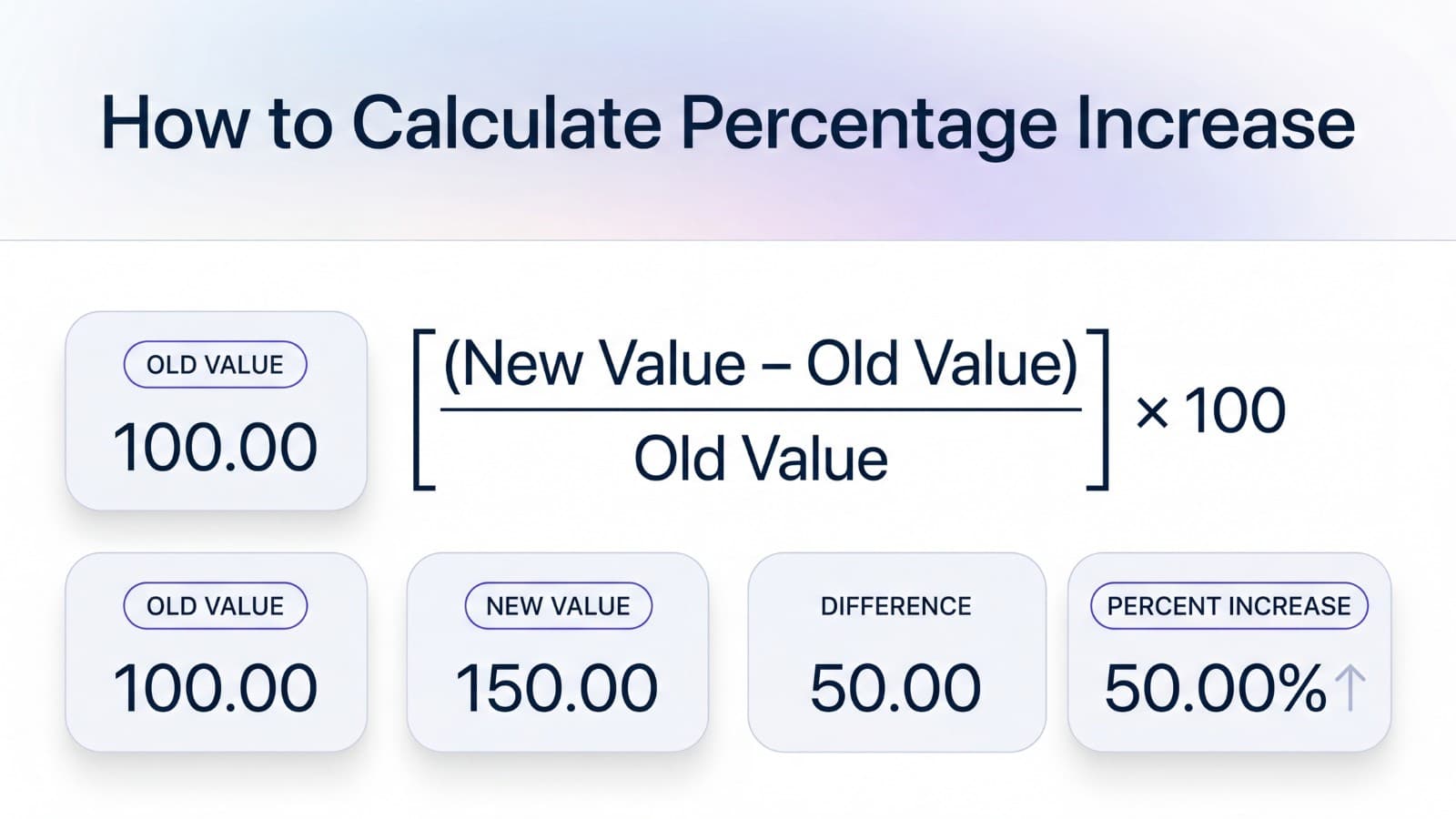
What does percentage increase mean?
Percentage increase compares an old value to a new, higher value. It expresses the gap between them as a percentage of the old value. The bigger the gap relative to the starting point, the larger the percentage.
The key word is relative. Going from 1 to 2 is the same absolute change (1 unit) as going from 1,000 to 1,001, but those are very different stories: a 100 percent increase versus a 0.1 percent increase. Percentage increase puts the change in the context of where it started.
If the new value is lower than the old value, you have a percentage decrease, not an increase. The math is the same, but the result is negative (or you can describe it as a decrease).
Percentage increase formula
The formula in plain English:
Subtract the old value from the new value, divide by the old value, then multiply by 100.
The same formula in math notation:
Percentage increase = ((new − old) / old) × 100
That is it. Three operations and one multiplication by 100. Every percentage-increase problem boils down to those steps. For a deeper look at the formula and what each piece of it means, see Percentage Increase Formula.
What each part of the formula means
- old value. The starting amount, before the increase. Sometimes called the original value or the base.
- new value. The ending amount, after the increase.
- new − old. The absolute increase. How many units the value went up.
- (new − old) / old. The increase as a fraction of the original. A value of 0.25 means the new amount is 25 percent of the original's size larger than the old amount.
- × 100. Converts the fraction into a percentage. 0.25 becomes 25 percent.
The denominator is the most common place people slip. It is always the old value, never the new one.
Step by step percentage increase example
Take an old value of 50 and a new value of 80.
- Subtract the old value from the new value: 80 − 50 = 30
- Divide the difference by the old value: 30 / 50 = 0.6
- Multiply by 100: 0.6 × 100 = 60
The percentage increase is 60 percent. You can sanity-check by going the other direction: 50 increased by 60 percent is 50 + (50 × 0.6) = 50 + 30 = 80.
Example 1: Price increase
A coffee shop raises the price of a latte from $4.00 to $5.00.
- 5.00 − 4.00 = 1.00
- 1.00 / 4.00 = 0.25
- 0.25 × 100 = 25
The price went up 25 percent.
For pricing-specific applications of the same arithmetic, two related calculators handle the common cases. The markup calculator applies a percentage to a wholesale cost to get a retail price, and the sales tax calculator adds a tax percentage to a base price. Both follow the same rule: a percentage of the original, added on top.
Example 2: Salary increase
Someone gets a raise from $60,000 to $66,000 per year.
- 66,000 − 60,000 = 6,000
- 6,000 / 60,000 = 0.1
- 0.1 × 100 = 10
The raise is a 10 percent increase. Notice the absolute increase ($6,000) feels bigger than the percentage (10 percent), which is exactly why both numbers are useful: the absolute change is the money in your pocket, the percentage is the comparison to where you started.
Example 3: Traffic increase
A website goes from 8,000 monthly visitors to 12,000.
- 12,000 − 8,000 = 4,000
- 4,000 / 8,000 = 0.5
- 0.5 × 100 = 50
Monthly traffic is up 50 percent. The multiplier (1.5) tells you the same thing in a different way: the new traffic is 1.5 times the old traffic.
Percentage increase vs percentage change
Percentage change is the general term for any movement between two values, in either direction. Percentage increase is the specific case where the new value is higher.
- New higher than old: percentage increase. Result is positive.
- New lower than old: percentage decrease. Result is negative (or you can describe it as a decrease without the minus sign).
The formula is the same in both cases. The sign of the answer tells you which direction you went.
For applying a percentage decrease to a price (a sale or markdown), the discount calculator handles that specific case directly.
Common percentage increase mistakes
A few traps that catch people, even when the formula itself is clear:
- Dividing by the new value instead of the old. The denominator is always the original number. Going from 50 to 80 is a 60 percent increase (30/50), not 37.5 percent (30/80).
- Confusing percentage increase with absolute increase. A jump from 1 to 2 is a 100 percent increase. A jump from 1,000 to 1,001 is only 0.1 percent. Same one-unit change, very different stories.
- Adding percentages from multiple stages. A 10 percent increase followed by another 10 percent increase is a 21 percent increase total, not 20 percent. Each stage is calculated against a new base.
- Forgetting to multiply by 100. A result of 0.6 is a fraction, not a percentage. The percentage is 60.
- Calling a negative result an increase. A negative answer means the new value is lower than the old. That is a decrease, not a small increase.
When to use a percentage increase calculator
Doing the math by hand is fine for one or two values. For anything more, a calculator is faster and avoids arithmetic slips. The percentage increase calculator takes an old value and a new value and returns the percentage change, the absolute change, and the multiplier in one step. It also handles negative starting values cleanly, which trips up the basic formula.
For a quick sanity check by hand, the multiplier is the easiest way to verify a percentage. A 25 percent increase should multiply the old value by 1.25; a 60 percent increase by 1.6. If your final answer fails that check, recompute.
Quick summary
- Formula: ((new − old) / old) × 100
- Always divide by the old value, never the new value.
- A positive result is an increase. A negative result is a decrease.
- An increase greater than 100 percent means the new value is more than double the old value.
- For multi-step increases, do not just add the percentages. Each stage uses a new base.
- The percentage increase calculator handles the math in one step and reports the multiplier alongside the percentage.
Run the numbers
Three calculators that all use percentage increase or its close relatives.