



Resources · Health
What Is TDEE?
TDEE is short for Total Daily Energy Expenditure. It is an estimate of how many calories your body burns in a typical day, including your resting metabolism plus everything else you do. If you have ever set a daily calorie target for weight loss, maintenance, or muscle gain, TDEE is usually the number behind it. This guide explains what TDEE means in plain language, what it includes, how it relates to BMR and activity level, and how to use it for maintenance calories, weight loss, or muscle gain.
7 min read

What does TDEE mean?
TDEE stands for Total Daily Energy Expenditure. The phrase “energy expenditure” is a longer way of saying “calories burned.” The word “total” means the full 24-hour figure, not just the calories you burn at rest.
Said simply: TDEE is your best guess at how many calories you burn in a typical day, all activity included. It is the same idea as your maintenance calorie figure, just in technical language.
For a fast estimate, the TDEE calculator takes your sex, age, height, weight, and activity level and returns a number in a few seconds.
What TDEE includes
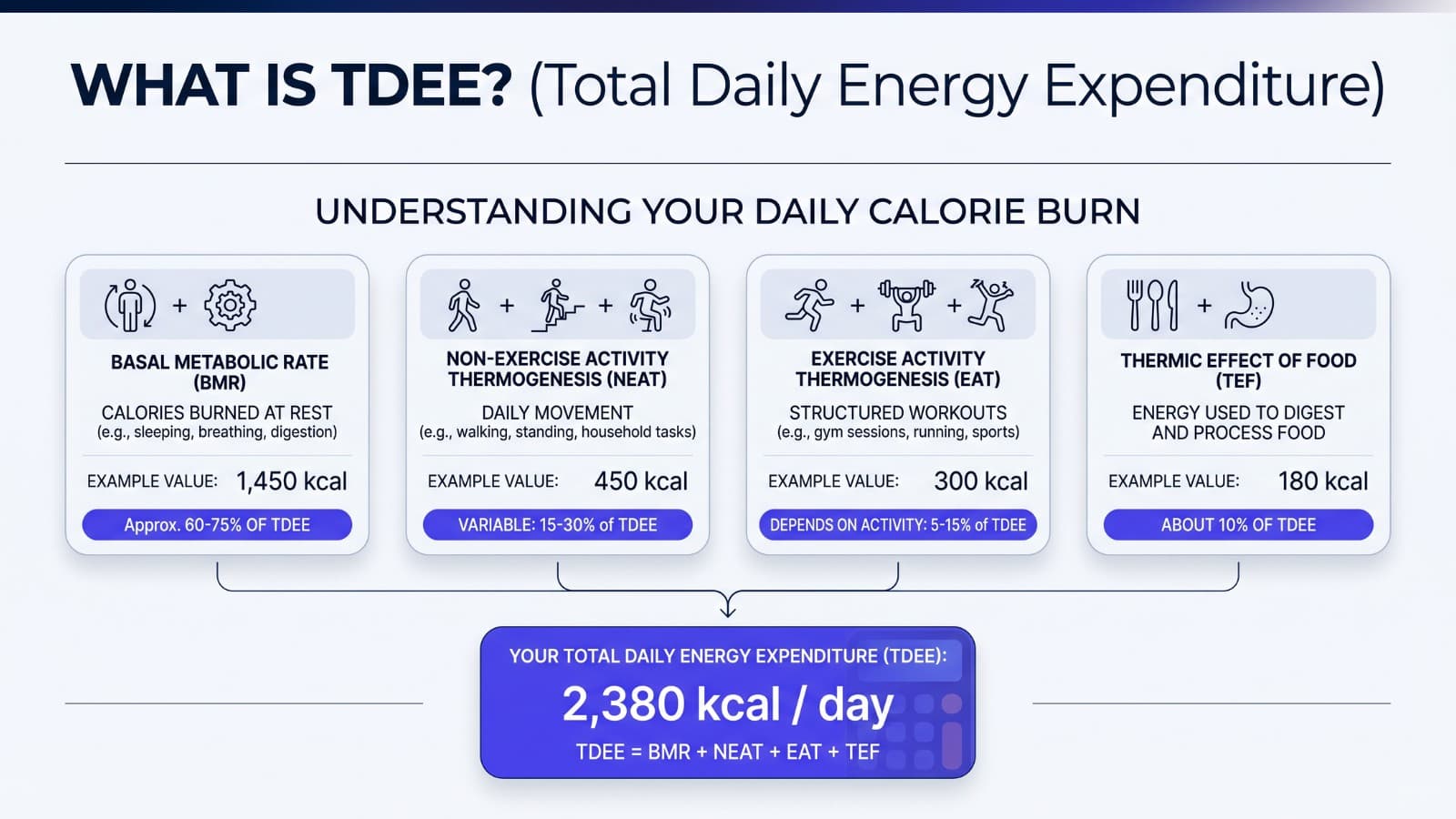
TDEE has four parts:
- Basal metabolic rate (BMR). The calories your body burns at rest just keeping you alive. This is the largest single piece for most people. The BMR calculator estimates this directly.
- Daily movement. Walking, standing, fidgeting, household chores. Researchers sometimes call this NEAT (non-exercise activity), but for our purposes it is just “moving around.”
- Exercise. Workouts, sports, and any intentional training.
- Thermic effect of food. The calories your body burns digesting what you eat. Usually about 10 percent of your daily intake.
Add these together and you get TDEE.
TDEE vs BMR
The short version: BMR is what you burn at rest. TDEE is BMR plus everything else.
If you stayed in bed all day and did nothing, you would burn about your BMR. As soon as you stand up, walk to the kitchen, eat breakfast, and go to work, you start adding calories on top of BMR. TDEE is the running total at the end of the day.
For a side-by-side comparison and when to use each one, see BMR vs TDEE.
How activity changes TDEE
Activity is the lever that turns BMR into TDEE. Without any activity at all, TDEE would equal BMR. Once you account for real-world life, TDEE is always larger.
The standard activity multipliers are:
- Sedentary (1.2): little or no exercise, mostly desk work.
- Lightly active (1.375): light exercise 1 to 3 days per week.
- Moderately active (1.55): moderate exercise 3 to 5 days per week.
- Very active (1.725): hard exercise 6 to 7 days per week.
- Extra active (1.9): physically demanding job, daily training, or both.
Even a sedentary office worker has a TDEE that is about 20 percent higher than BMR. A moderately active lifter is 55 percent higher. Most people overestimate this number, so when in doubt pick the lower level and verify with a couple of weeks of weight tracking.
The TDEE formula
The formula has two pieces:
The TDEE formula
TDEE = BMR × activity factor
Mifflin–St Jeor BMR
- Men: 10 × weight kg + 6.25 × height cm − 5 × age + 5
- Women: 10 × weight kg + 6.25 × height cm − 5 × age − 161
Activity factors
- Sedentary: 1.2
- Lightly active: 1.375
- Moderately active: 1.55
- Very active: 1.725
- Extra active: 1.9
BMR is typically estimated using the Mifflin–St Jeor equation, the most widely used BMR formula in modern nutrition references. Once you have BMR, multiply by the activity factor that matches your typical week to get TDEE.
TDEE example calculation
Take a 30-year-old man, 180 lb, 5 ft 10 in, with a moderate activity level. Convert the units first.
- Weight: 180 × 0.45359 ≈ 81.65 kg
- Height: 70 in × 2.54 = 177.8 cm
- Age: 30
Plug those into Mifflin–St Jeor for men, then multiply for TDEE:
- BMR: 10 × 81.65 + 6.25 × 177.8 − 5 × 30 + 5 ≈ 1,783 calories
- Activity factor: 1.55 (moderately active)
- TDEE = 1,783 × 1.55 ≈ 2,763 calories per day
This means the estimate for maintaining weight is about 2,763 calories per day before any intentional deficit or surplus. The TDEE calculator produces the same result for these inputs and rounds to the nearest whole calorie. For the step-by-step walkthrough of the same calculation, see How to Calculate TDEE.
Example summary
30M · 5'10" · 180 lb · moderate
BMR ≈ 1,783 kcal · TDEE ≈ 2,763 kcal/day
TDEE and maintenance calories
Maintenance calories and TDEE describe the same number. Eat roughly your TDEE figure each day and your weight tends to stay stable. Eat below it and you lose weight; eat above it and you gain.
Because TDEE is an estimate, plan to verify it. Track your weight a few times a week for 2 to 3 weeks, then look at the 7 to 14 day average. If it is roughly flat, you have your maintenance figure. If it drifts, nudge calories up or down by 100 to 200 per day until things stabilize.
TDEE for weight loss
Intake below TDEE is what produces a deficit. This page names no figure of its own, and the reason is that the published ones are larger than the 250 to 500 it used to give: the NHLBI obesity guideline recommends a deficit of 500 to 1,000 calories a day, its lowest figure anywhere is 300 to 500 for a BMI of 27 to 35, and the 2013 AHA/ACC/TOS guideline prescribes 500 or 750. At the static 3,500 calories per pound conversion, 500 a day is about 1 lb a week. That conversion is a 1958 average rather than a constant, so a fixed daily deficit produces less change over time than the multiplication suggests.
Bigger deficits are not always better. Aggressive cuts can be hard to stick with, raise hunger and fatigue, and tend to slip back. A modest deficit you can hold for a few months will usually outperform an extreme one you abandon after two weeks. Cuts beyond 500 calories per day below TDEE should be supervised by a qualified professional.
If you also want to compare your current weight to a standard healthy range for your height, the BMI calculator gives you a separate point of reference.
TDEE for muscle gain
Intake above TDEE is what produces a surplus, and this page names no figure of its own. One named body does publish one, for a different question: the NHS tells underweight adults they "could try adding around 300 to 500 extra calories a day", which is about gaining weight generally rather than gaining muscle, and note that it is 300 to 500 rather than the 250 to 500 that circulates. For muscle gain specifically no body gives a number: the ISSN position stand declines to name one and says the magnitude depends on training status, and the ACSM, Academy of Nutrition and Dietetics and Dietitians of Canada joint position stand publishes no daily surplus either.
Larger surpluses tend to add more fat than muscle, especially for people who are not new to lifting. Recompute your TDEE every few months because it shifts as your weight grows. Once you have a daily calorie target, the macro calculator splits it into protein, carbs, and fat in grams.
How to estimate your TDEE
Two paths, same answer. The fast way is the TDEE calculator, which takes a few inputs and returns BMR, TDEE, and calorie targets in seconds. The slower-but-more-instructive way is to run the math yourself: compute BMR with the BMR calculator (or by hand using Mifflin–St Jeor), then multiply by the activity factor that best matches your typical week.
For the full step-by-step walkthrough, including unit conversions and a worked example, see How to Calculate TDEE.
Why TDEE is only an estimate
TDEE comes from a population formula, not direct measurement. Real-world results depend on a lot of things the formula cannot see:
- Tracking accuracy. Nutrition labels and apps both have margins of error.
- Metabolism. Two people with the same height, weight, age, and sex can have BMRs that differ by 10 percent or more.
- Activity. The activity multiplier is a rough guess about your average week.
- Exercise intensity. The same workout done harder or longer burns different amounts.
- Muscle mass. More lean tissue means a higher BMR.
- Consistency. What you do most days matters more than any single workout or meal.
Plan for the number to be a starting point. After 2 to 3 weeks at your target, the scale will tell you whether to nudge it up or down.
Common mistakes
A few traps that catch people:
- Picking too high an activity multiplier. Most people overestimate. A desk job with three exercise sessions per week usually sits at lightly active, not moderate. Inflated activity inflates TDEE.
- Treating TDEE as a precise number. The formula is precise; the inputs are not. Use TDEE as a starting point and adjust based on 2 to 3 weeks of weight tracking.
- Using BMR as a calorie target instead of TDEE. BMR is only the resting half. Setting calorie targets at BMR effectively means eating well below what your body actually uses, which is hard to sustain.
- Ignoring weekly averages. Body weight bounces around daily from water, sodium, and glycogen. Compare 7 to 14 day averages, not single-day weights.
- Forgetting to recompute. TDEE shifts as your weight, age, or activity changes. The same target a year ago may not match your current body.
When TDEE changes
TDEE is not fixed. It moves whenever the inputs move:
- Body weight. A 10 lb (about 4.5 kg) change in either direction is enough to shift TDEE by roughly 100 calories per day for most adults.
- Activity pattern. A new training program, a more sedentary job, an injury that limits exercise, or a busy season at work all change the activity multiplier you should use.
- Age. BMR drifts down slowly with age (the formula subtracts 5 calories per year for both men and women), so TDEE drifts down with it.
- Body composition. More lean mass means a higher BMR and a higher TDEE at the same body weight.
Practical advice: recompute when your weight changes by 10 lb or more, when your activity pattern shifts meaningfully, or when 6 to 12 months have passed since the last calculation. The TDEE calculator runs in seconds, so rerunning it whenever something meaningful changes is cheap insurance.
Quick summary
- TDEE stands for Total Daily Energy Expenditure.
- It estimates how many calories your body burns in a typical day.
- It includes BMR plus daily movement, exercise, and digestion.
- TDEE is almost always higher than BMR.
- TDEE is the same idea as your maintenance calorie figure.
- It is an estimate, so use it as a starting point and adjust based on results.
- The TDEE calculator gives you a number in a few seconds.
Run the numbers
Three calculators that come up alongside TDEE: the resting half (BMR), the full daily figure (TDEE), and the macro split you might want once you have a calorie target.
Related guides
- How to Calculate TDEE step-by-step walkthrough of the BMR plus activity-factor calculation.
- BMR vs TDEE side-by-side comparison of resting calorie burn versus total daily burn.