



Resources · Money
How to Calculate a Loan Payment
A loan payment is the fixed monthly amount that pays down a loan over a set term. The math behind it is the standard amortized loan payment formula, which splits each payment into interest and principal until the balance reaches zero on the last scheduled payment. This guide walks through the formula, the step by step calculation, a worked example, and how extra payments change the result.
7 min read

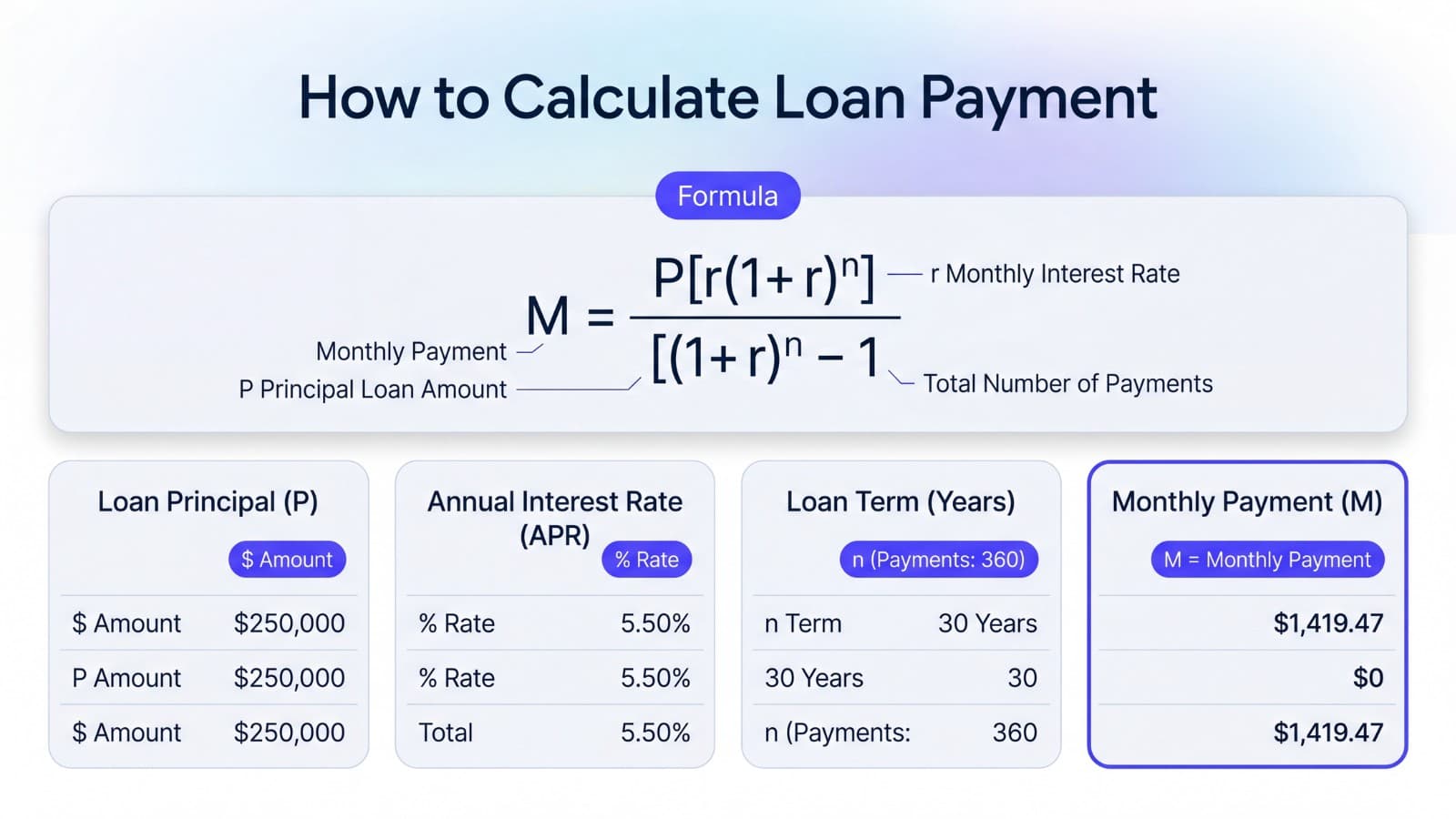
What a loan payment includes
On a fixed-rate amortizing loan, every monthly payment is the same size. Inside each payment, the split between principal and interest shifts over time: early payments are mostly interest because the balance is large, and later payments are mostly principal because the balance is small. By the last payment, the balance has been paid down to zero.
The fastest way to see this in action is the loan calculator. Enter the loan amount, the annual interest rate, and the term, and the scheduled payment, total interest, and payoff time are ready instantly. The rest of this guide explains where the number comes from.
The loan payment formula
The standard amortized loan payment formula is short to write and a little dense to read. The two formulas below cover the normal case and the special case where the rate is zero.
Monthly loan payment
M = P × r × (1 + r)^n / ((1 + r)^n − 1)
The parts
- M = monthly payment
- P = loan amount (principal)
- r = monthly interest rate (annual interest rate ÷ 12 ÷ 100)
- n = number of monthly payments
At a 0 percent interest rate
M = P / n
How to calculate a loan payment step by step
- Convert the annual interest rate to a monthly rate. Divide the annual interest rate by 12, then by 100 to get the monthly rate r as a decimal. For an 8 percent annual interest rate, r = 8 ÷ 12 ÷ 100 ≈ 0.006667. This treats the quoted figure as a nominal annual rate with monthly compounding, which is the convention for ordinary instalment loans. An effective annual rate would instead convert as (1 + rate)^(1/12) − 1.
- Find the number of monthly payments. Multiply the term in years by 12. A 5 year loan has 60 monthly payments.
- Plug into the formula. Compute (1 + r)^n once, then use the result in both the numerator and the denominator.
- Round the monthly payment. Round to the nearest cent. The total interest is the monthly payment times n, minus the loan amount.
Worked example
Loan amount $10,000, annual interest rate 8 percent, term 5 years (60 monthly payments).
- r = 0.08 ÷ 12 ≈ 0.006667
- n = 5 × 12 = 60
- (1 + r)^60 ≈ 1.489846
- Numerator: 10,000 × 0.006667 × 1.489846 ≈ 99.323
- Denominator: 1.489846 − 1 = 0.489846
- M ≈ 99.323 ÷ 0.489846 ≈ $202.76 per month
The totals fall out from there:
- Total of payments = 202.763943 × 60 ≈ $12,165.84
- Total interest = 12,165.84 − 10,000 ≈ $2,165.84
The monthly payment is $202.76 once rounded, but the totals above use the unrounded $202.763943. That is why 202.76 × 60 comes to $12,165.60 rather than $12,165.84: rounding once, at the end, keeps the totals consistent with the formula. Lenders that bill a cent-rounded payment normally adjust the final instalment instead.
The loan calculator produces the same numbers for these inputs.
How extra payments change payoff time
In this model interest accrues on the balance first, the combined payment covers that interest, and everything above it reduces principal — so adding to the scheduled payment retires principal faster. That shrinks the balance, which shrinks next month's interest, which lets a bigger slice of the next scheduled payment go to principal too. The effect compounds, and the loan pays off ahead of schedule. Lenders differ in how they credit extra money — to principal, to the next scheduled payment, or to fees — so check your loan agreement and tell the servicer how you want additional payments applied.
With the same $10,000 loan at 8 percent for 5 years, adding $50 per month on top of the scheduled $202.76 cuts the payoff from 60 months down to about 47 months. Total interest drops from $2,165.84 to roughly $1,648, saving about $518 with about 13 months of payments saved as well. Even modest extra payments add up.
Interest rate, APR, and loan term
The interest rate and the APR are different numbers. The CFPB describes the interest rate as what you pay the lender for borrowing, and the APR as “the interest rate plus any additional fees charged by the lender,” including origination charges. The formula on this page needs the periodic rate that generates the monthly interest, so it takes the interest rate. Dividing a disclosed APR by 12 matches that periodic rate only when the loan carries no such fees.
APR is designed to make cost comparisons easier, and the CFPB advises comparing APRs with APRs rather than against interest rates — while cautioning against judging a loan on APR alone, because term, amount, and how long you keep the loan also matter. For a deeper look at the two figures, see APR vs interest rate.
Loan term works in the other direction. For the same loan amount and interest rate, longer terms lower the monthly payment and raise total interest, while shorter terms raise the monthly payment and lower total interest. For a percentage comparison between two scenarios, the percentage increase calculator can quantify the difference.
Common mistakes
- Using APR where the interest rate belongs. On a loan with origination or broker fees the two are not the same number, and the formula needs the interest rate.
- Comparing offers on the monthly payment alone, without checking the total interest paid over the term.
- Forgetting that fees rolled into the loan also earn interest over the life of the loan.
- Assuming an extra payment that doesn't exceed the monthly interest will move the payoff. The extra has to actually reduce principal to help.
- Forgetting that this formula covers interest only. Any separate lender fees are outside the payment it produces.
What this formula assumes
- A fixed interest rate and equal monthly payments that fully amortize the balance to zero on the last scheduled payment.
- Interest accruing once per month on the outstanding balance, rather than daily simple-interest accrual.
- A whole number of monthly payments, and no fees. Adjustable rates, interest-only periods, and balloon payments need different math.
- Rounding only at the end. Totals are computed from the unrounded payment, so multiplying a rounded monthly figure by the number of payments can differ by a few cents.
Sources
- CFPB — the difference between a loan's interest rate and its APR — states that the APR is the interest rate plus additional lender fees such as origination charges, and that APRs should be compared with APRs. This supports using the interest rate in the formula.
- CFPB — mortgage interest rate versus APR — describes APR as a broader measure of borrowing cost that “reflects the interest rate, any points, mortgage broker fees, and other charges.”
- CFPB — what is included in a monthly mortgage payment — gives the total as principal plus interest plus mortgage insurance if applicable plus escrow for homeowners insurance and taxes, and notes association fees are usually paid separately.