



Resources · Money
How to Calculate a Car Payment
A car payment combines a loan and a sales tax. The loan piece uses the standard amortized loan payment formula. The sales tax piece depends on your state and whether you have a trade in. This guide walks through both, with a worked example using realistic defaults.
7 min read

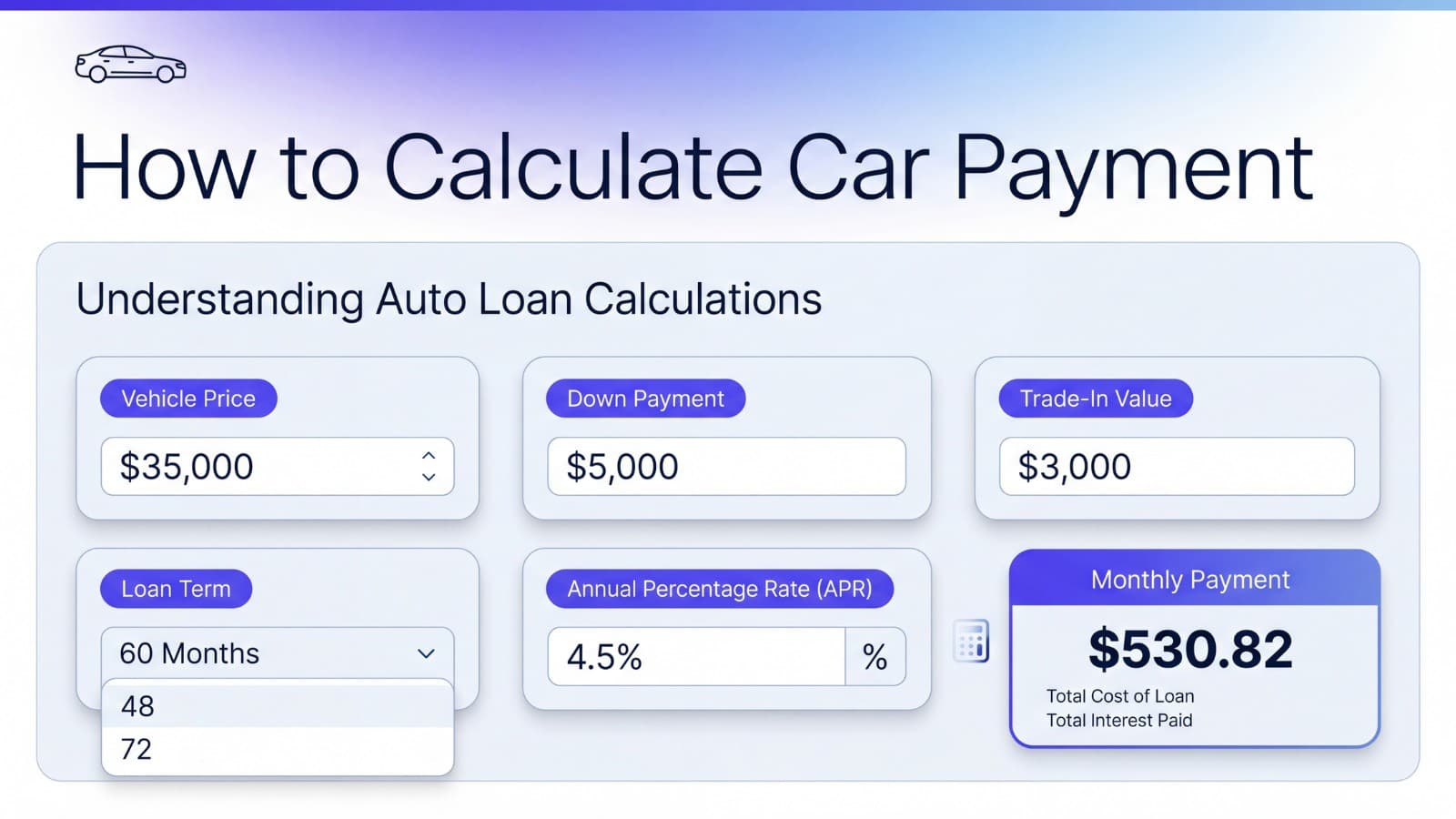
What a car payment includes
The monthly car payment you make to the lender covers the amount financed plus interest. The amount financed is not just the sticker price: it is the vehicle price minus your down payment and any trade in, plus the sales tax and any rolled-in fees. After the loan starts, each monthly payment is the same size, split between interest and principal in a ratio that shifts over time.
The fastest way to see the numbers is the car payment calculator. Enter the price, down payment, trade in, sales tax, term, APR, and fees, and the result and breakdown are ready instantly.
The car payment formula
The car payment is the amortized loan payment, applied to the amount financed.
Amount financed
amount financed = vehicle price − down payment − trade in + sales tax + fees
Monthly car payment
M = P × r × (1 + r)^n / ((1 + r)^n − 1)
The parts
- M = monthly payment
- P = amount financed
- r = monthly interest rate (APR ÷ 12 ÷ 100)
- n = number of monthly payments
At 0 percent APR
M = P / n
How to calculate a car payment step by step
- Start with the vehicle price. Use the negotiated price, not the sticker.
- Subtract down payment and trade in. The result is the loan amount before tax.
- Compute sales tax. Multiply the vehicle price minus the trade in by the sales tax rate. In most U.S. states, the trade in lowers the taxable base.
- Add tax and fees. Add the sales tax and any rolled-in fees to the loan amount before tax to get the amount financed.
- Run the loan formula. Convert APR to a monthly rate, multiply the term in months by 1, and plug everything into the amortization formula.
- Compute totals. Total of payments is M times n. Total interest is the total of payments minus the amount financed. Total cost is total of payments plus the down payment.
Down payment and trade in value
Both reduce the amount financed dollar for dollar. A down payment is cash out of pocket; a trade in is the dealer's credit for your old vehicle. In many U.S. states the trade in value is also subtracted from the taxable price, which lowers the sales tax bill as well, so a trade in can save money in two places at once.
Sales tax and fees
Sales tax in the U.S. is set at the state and local level. Combined rates typically range from 0 percent to over 10 percent. Most states tax the vehicle price minus the trade in value. Title, registration, and document fees are usually small but can be rolled into the loan, in which case they accrue interest over the term. For checking just the tax portion of any amount, the sales tax calculator does it in one step.
APR and loan term
APR is the annualized cost of the loan. A higher APR raises both the monthly payment and the total interest paid. Term works in the other direction: longer terms lower the monthly payment but raise total interest because the balance is outstanding longer. For a percentage comparison between two APR scenarios, the percentage increase calculator can put the difference in plain terms.
Worked example
Vehicle price $30,000, down payment $3,000, trade in $0, sales tax 6 percent, loan term 60 months, APR 7 percent, fees $0.
- Sales tax: 30,000 × 0.06 = $1,800
- Loan amount before tax: 30,000 − 3,000 − 0 = $27,000
- Amount financed: 27,000 + 1,800 = $28,800
- r = 0.07 ÷ 12 ≈ 0.005833
- n = 60
- (1 + r)^60 ≈ 1.417625
- M ≈ 28,800 × 0.005833 × 1.417625 ÷ 0.417625 ≈ $570.27 per month
The totals over the term follow from there:
- Total of payments ≈ $34,216.47
- Total interest ≈ $5,416.47
- Total cost incl. down payment ≈ $37,216.47
The car payment calculator produces these same numbers for these inputs.
Car payment vs total cost
The monthly payment is what hits your budget each month, but it is not the total cost of buying the car. Total cost includes every monthly payment over the loan plus the down payment. When comparing two offers, compare the total cost, not just the monthly payment. A loan with a smaller payment but a much longer term can easily cost more in total than a loan with a higher payment and a shorter term.
Common mistakes
- Forgetting that taxes and fees rolled into the loan also accrue interest.
- Picking a longer term to lower the monthly payment without checking how much extra total interest that costs.
- Quoting APR and monthly interest rate as if they were the same number. Monthly rate is APR divided by 12.
- Ignoring the down payment when comparing total cost between offers.
- Confusing loan amount before tax with amount financed. The amount financed adds the sales tax and any rolled-in fees.